

Precision Optical Mirrors, Polished and Coated in Rye
Kingsview Optical is an optical mirror manufacturer for OEMs, instrument makers and research labs. We make flat, concave and convex mirrors to your drawing, polish them on our own lines and coat them in our own vacuum chambers with aluminium, silver, gold or a dielectric design for your wavelength. Front or rear surface, prototype or production, all at our site in Rye, East Sussex.
- Made in Rye, East Sussex
- Coated in-house
- Metal and dielectric
- ISO 9001:2015

From Glass Blank to Coated Mirror, in Rye
The substrate and the coating are made under one roof. You deal directly with the engineers who polish and coat your mirrors, with one set of quality records from blank to finished part.
East Sussex TN31 7TE

CNC Edging
Send us a STEP file. Our CAD/CAM CNC edger cuts round, rectangular and custom mirror outlines, with chamfers, steps and holes.
Flat Polishing
Flat mirror substrates are polished to λ/4 at 633nm as standard, on the same lines that make our windows and prisms.

CNC Curve Polishing
Concave and convex spherical mirrors are polished on our Optotech CNC lines, to a radius tolerance of 0.5% or better.
Mirror Coating
Aluminium, silver, gold and dielectric coatings go on in our own vacuum chambers. Each coating is designed in Essential Macleod first.
Optical coatingMeasured Before It Leaves
We check surface form on our 4″ Zygo interferometer and reflectance on our Lambda 1050+ spectrophotometer, from 200nm to 3000nm.


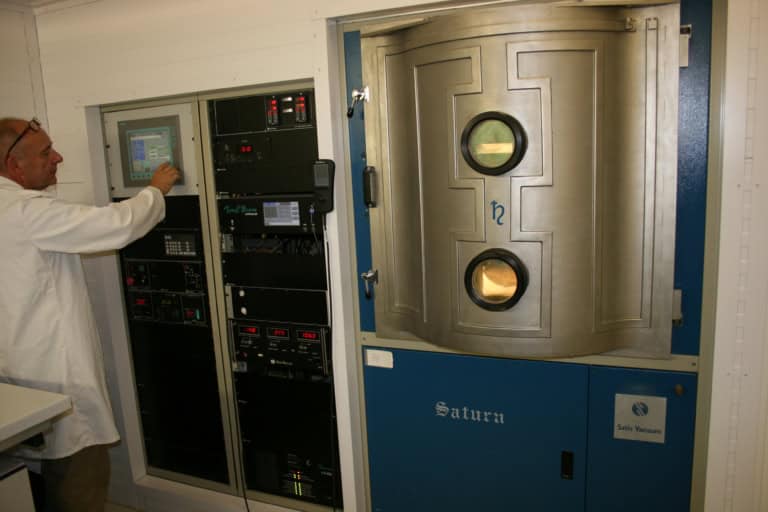

Every photo on this page was taken at our site in Rye.
Custom Optical Mirrors We Manufacture
Every mirror is made to your drawing, in the shape, surface and coating your system needs. The drawings show how each type handles light.


Choosing a Mirror Coating
The right coating depends on your wavelength range, angle of incidence and environment. If you're not sure, tell us how the mirror will be used and we'll recommend one.
| Protected aluminium | The most common mirror coating. About 86% reflectance across the visible, broadband from UV to IR, and tough enough for everyday handling. Most mirror applications are well served by it. |
|---|---|
| Enhanced aluminium | A dielectric multilayer over aluminium lifts visible reflectance to about 94 to 95%, while keeping the coating tough. |
| Protected silver | The highest visible reflectance of any metal, 95 to 96% and above, and strong in the near infrared. Silver is less durable than aluminium and harder to clean, so it isn't the best choice outdoors or in harsh conditions. |
| Protected gold | For the infrared. Typically about 96% average reflectance from 0.8 to 20 microns. |
| Dielectric | Very high reflectance at a defined wavelength band and angle of incidence, with a hard, durable coating. It can also suppress other wavelengths, so the mirror doubles as a filter. Performance depends on wavelength and angle, so for wide bands or wide angles a metal mirror is usually the better choice. |
| Partial reflectors and beamsplitters | Custom reflect and transmit ratios, designed for your wavelength and angle of incidence. |
Mirrors That Steer, Fold and Focus Light in Other People's Systems
Our customers are engineers who need a mirror to send light exactly where it should go, with the reflectance their system was designed around.
Optical Mirror Specification
These are our standard tolerances. If your design needs tighter, tell us which parameter. We'll tell you plainly whether we can hold it, and what it adds to cost.
| Mirror types | Flat, concave and convex spherical |
|---|---|
| Outlines | Round, rectangular and custom profiles from your STEP file |
| Size range | Small precision mirrors through to large flats |
| Dimension tolerance | ±0.1mm |
| Flatness (flat mirrors) | λ/4 @ 633nm, tighter on request |
| Radius tolerance (spherical) | 0.5% of radius or better |
| Irregularity (spherical) | λ/4 |
| Surface quality (scratch-dig) | 60/40 |
| Substrates | Schott, Ohara and CDGM optical glass; UV fused silica; others on request |
| Coatings | Protected and enhanced aluminium, protected silver, protected gold, dielectric, partial reflectors |
| Coated face | Front surface or rear surface |
| Coating test data | Lambda 1050+ spectrophotometer, 200nm to 3000nm, traces on request |
Not sure what to specify? Give us the wavelength range, angle of incidence and environment, and we'll suggest a coating and a substrate thickness that holds its flatness once coated.
See Your Mirrors Being Made
Planning a production run, or qualifying a new supplier? Come to Rye, see the polishing lines and coating chambers, and meet the engineers who would make your mirrors.
Optical Mirror FAQs
What's the difference between a front-surface and a rear-surface mirror?
Which mirror coating should I choose?
Can you make a dielectric mirror for my laser wavelength?
Do you make concave and convex mirrors?
How flat can you make a flat mirror?
Can you supply coating test data?
What do you need for a mirror quote?
Other Optics We Make
Getting a Quote for Custom Optical Mirrors
Send us your STEP file or drawing. An engineer from the team that would make your mirrors, not a sales team, will review it. They'll tell you plainly what's achievable and what will drive cost.
What to send
- STEP file and drawing (PDF or ISO 10110)
- Mirror type, with the radius or flatness you need
- Coating, wavelength range and angle of incidence
- Front or rear surface, and the operating environment
- Quantities: prototypes and expected production volumes
What happens next
- An engineer reviews itWithin one working day, flagging anything that will drive cost or lead time.
- We quote the mirrorFor the prototype, and for production at your volumes.
- We make, coat, measure and deliverAll in Rye, with coating traces and inspection data if you need them.
Need a Custom Optical Mirror?
Send your STEP file or drawing. We'll tell you plainly how we'd make it, what it will cost and how long it will take.
Made in Rye, East Sussex. NDA-friendly. Defence and security work welcome. ISO 9001:2015.