

A 750mm Borescope, Redesigned and Built in 8 Weeks
The customer came to us with another supplier's lens design and asked us only to manufacture it. We redesigned it with less than half the lens elements, then made the optics, the metalwork and the finished borescope at our site in Rye, East Sussex.

An HD Image Through a 25mm Diameter, 700mm Long Bore
The customer needed a 750mm borescope that would fit through a 25mm hole. It had to deliver a 20° diagonal field of view across the visible band (400–700nm) onto a 1-inch, 20MP sensor, such as the Teledyne FLIR Blackfly S BFS-U3-200S6C-C, with focus adjustable from 3 to 10 metres.
A long, narrow bore means the image is passed down the tube by many lens elements in series. Every element adds a little manufacturing error, and across a long relay those errors add up.
The real design problem is not reaching the resolution on paper. It is keeping that resolution once real parts are made and assembled.
Costly to make, and the tolerance build-up across so many elements would have left the image quality poor.
They came to us for manufacture only. After our review they moved the design to us too: fewer parts to make and align, each section built to hold its performance.
Three Optical Sections, Each Designed to Tolerate Real Manufacture
We split the system into three sections and optimised each one in Zemax for low sensitivity to manufacturing deviation, so realistic tolerances would still deliver the specified image.
- 01
Objective
Captures the 20° field of view at the tip, within a body that fits through a 25mm hole.
- 02
Relay Section
Carries the image along the 750mm length without element errors compounding.
- 03
Focusing Section
Moves the last lens to focus from 3 to 10 metres onto the 1-inch sensor.

Mechanical Design
The tube had to be rigid enough over its 750mm length not to flex and pull the optics out of alignment. Focus is set by a mechanism that moves the last lens, adjusting the focus from 3 to 10 metres, driven by a knurled ring sized to be turned accurately with gloved hands.
Our design engineers work beside the people who make the parts, so every choice was checked against what our lens line and machine shop can actually produce. There was no redesign halfway through.
Made in Rye, Start to Finish
With one supplier carrying the whole project there was no shared blame between a designer and a manufacturer. If the assembly had not performed, putting it right was our responsibility alone.


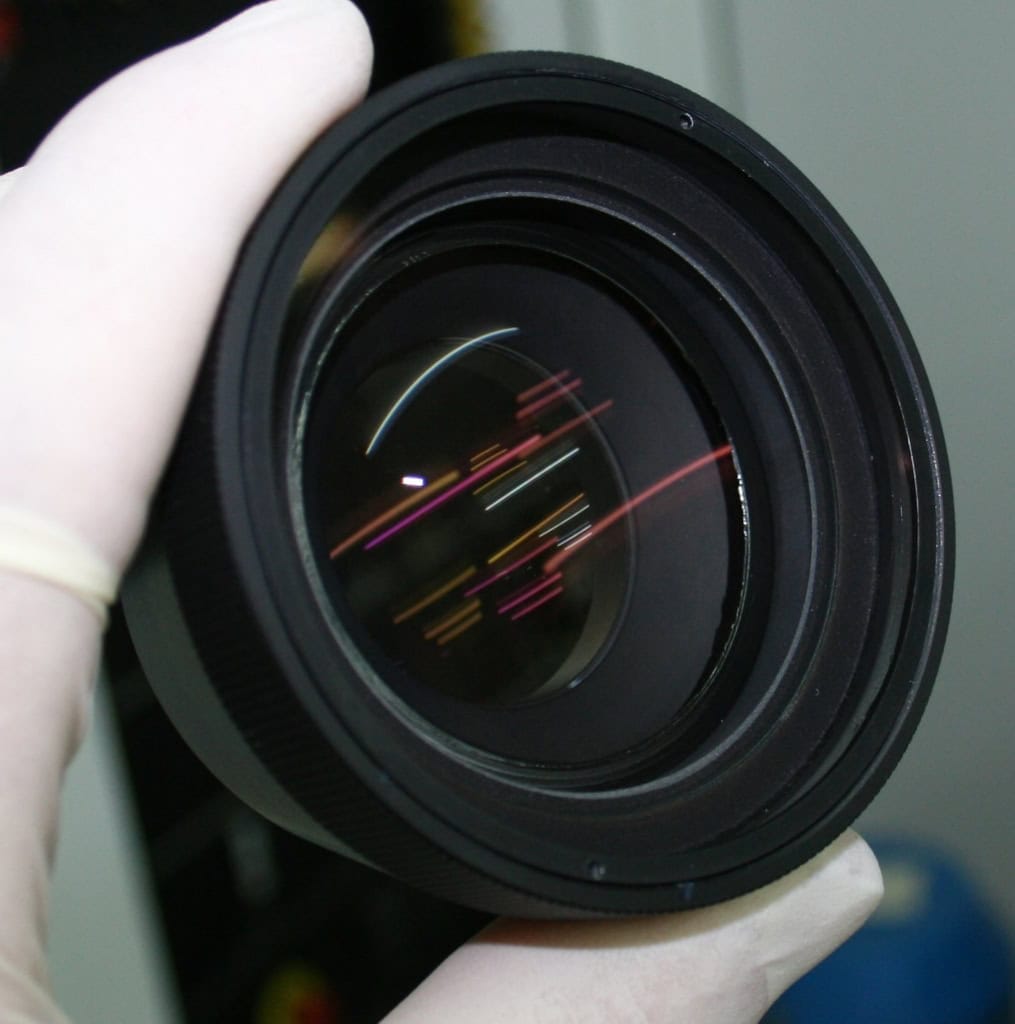
- Optical designThree-section layout and tolerance analysis in Zemax.
- Lens manufactureEvery lens made on our Optotech CNC lens line.
- MetalworkTube, cam and housings machined on site.
- AssemblyAssembled and aligned in house before delivery.
How Image Quality Was Secured

Predicted in Design
A Monte Carlo analysis simulated many borescopes built with random errors within our tolerances, showing how real units would perform and where tolerances could be relaxed to save cost.
Checked in Rye
Each assembly was checked for the specified field of view, even illumination with no vignetting, and an HD image across the field and focus range.
Accepted by the Customer
Final acceptance was carried out on the customer's own camera, in their own application.
Designed, manufactured and assembled in 8 weeks, with less than half the lens elements, and accepted by the customer in their application.
Got a Design That Looks Too Complicated to Build?
Send us your requirement or an existing design. An engineer who works beside our production line will tell you what can be simplified before you commit to manufacture.
We reply within one working day. All projects can be handled under NDA.