

Custom Notch Filters, Sputtered in Rye
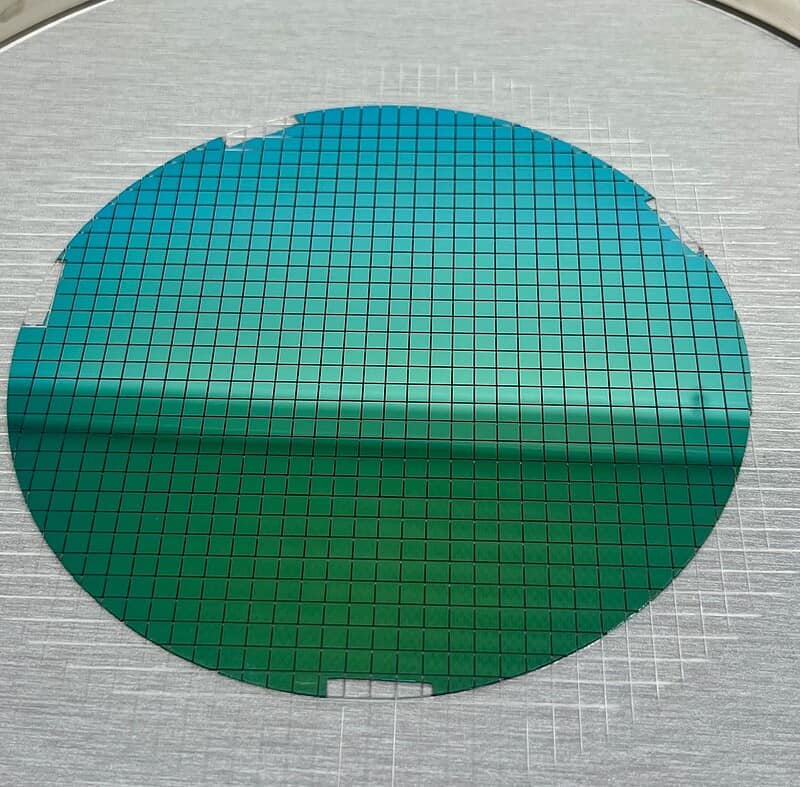
Kingsview Optical makes custom notch filters that block a laser line, or any narrow band, while transmitting the wavelengths either side. We design them in-house, coat them by magnetron sputtering, dice them to size and measure every batch at our site in Rye, East Sussex.
- Magnetron sputtered in Rye
- Diced in-house
- Every batch measured
- ISO 9001:2015
What a Notch Filter Does
In short: a notch filter is the opposite of a bandpass filter. It blocks one narrow band, usually a laser wavelength, and transmits the light either side, so you can see a weak signal right next to a bright laser.
Our notch filters are multilayer interference coatings. The layers are designed to reflect a narrow band very strongly while keeping the passbands either side clear and flat. The depth of the notch is quoted as optical density (OD) at the laser wavelength.
The classic use is Raman spectroscopy, where the Raman signal is far weaker than the laser that excites it. A deep notch removes the laser and lets the shifted light through. The same idea keeps a known laser line out of cameras and detectors.
The notch moves to shorter wavelengths as the filter tilts, so the design has to allow for the angle of incidence and any tolerance on the laser wavelength. Tell us both and we'll size the notch to suit.
Notch Filters We Make
Each notch filter is designed around your laser and your signal. These are the families most of our enquiries fall into.
| Type | What it does | Typical use |
|---|---|---|
| Laser line notch | A single deep notch at your laser wavelength, for example 405, 532, 633 or 785nm, with clear passbands either side. | Laser rejection in imaging and detection |
| Raman notch | A deep notch with steep edges, so Raman lines close to the laser are still transmitted. | Raman spectroscopy and analysers |
| Sensor protection | Blocks a known laser wavelength in front of a camera or detector while the rest of the scene stays visible. | Cameras and sensors near laser systems |
| Fluorescence notch | Removes the excitation line from the emission path. | Fluorescence imaging and diagnostics |
How We Make Your Notch Filters
All four steps happen at our site in Rye, so you deal with one supplier, one purchase order and one lead time, from prototype lots to repeat production.
Where Our Notch Filters Are Used
Notch Filter Specification
Every filter is designed to your numbers. These are typical figures; if your design needs tighter, tell us which parameter. We'll tell you plainly whether we can hold it, and what it adds to cost.
| Notch centre tolerance | ±2nm |
|---|---|
| Notch width | From about 20nm, measured at the blocking level you specify |
| Notch depth | Up to OD6 at the laser wavelength |
| Passband transmission | Typically above 90% average either side of the notch |
| Angle of incidence | 0° standard; other angles designed to order |
| Wavelength range | 300 to 3000nm, from the UV through the visible to the SWIR |
| Substrates | Fused silica, borosilicate and optical glass; we can coat your own substrate |
| Size | Coated on wafers up to 100mm diameter; diced filters from 0.8mm square, or single filters up to 100mm |
| Dimension tolerance | ±0.1mm standard; tighter on diced parts on request |
| Surface quality (scratch-dig) | 60/40 standard, 40/20 on request |
| Measurement | Every batch on a Perkin-Elmer Lambda 1050+, 200 to 3000nm; traces on request |
Not sure what to specify? Tell us the laser wavelength and its tolerance, how close to the laser you need to measure, and your angle of incidence. We'll design the notch and send a modelled curve with the quote.
Notch Filter Questions
What is the difference between a notch filter and a bandpass filter?
What OD do I need for Raman spectroscopy?
Can a notch filter protect a camera or sensor?
How close to the laser line can I see?
Does tilting the filter move the notch?
What do you need to quote a notch filter?
Related Filters and Coatings
Getting a Quote for Custom Notch Filters
Send the spectral requirement, even as a sketch of the curve. An engineer from the team that would make your filters, not a sales team, will review it and tell you plainly what's achievable and what will drive cost.
What to send
- Laser wavelength and its tolerance
- Optical density needed at the laser line
- Passband range and minimum transmission either side
- Angle of incidence, size and thickness
- Quantities: prototypes and expected production volumes
What happens next
- An engineer reviews itWithin one working day, confirming it's achievable and flagging anything that will drive cost or lead time.
- We model it and quoteThe quote comes with a modelled target curve to measure against.
- We coat, dice and measureAll in Rye, with measured traces if you need them.
Need a Notch Filter for Your Laser?
That's what our sputtering chamber is for. Send the curve you need and we'll come back with a design, a price and a lead time.
Made in Rye, East Sussex. NDA-friendly. Defence and security work welcome. ISO 9001:2015.