

Custom Bandpass Filters, Sputtered and Diced in Rye
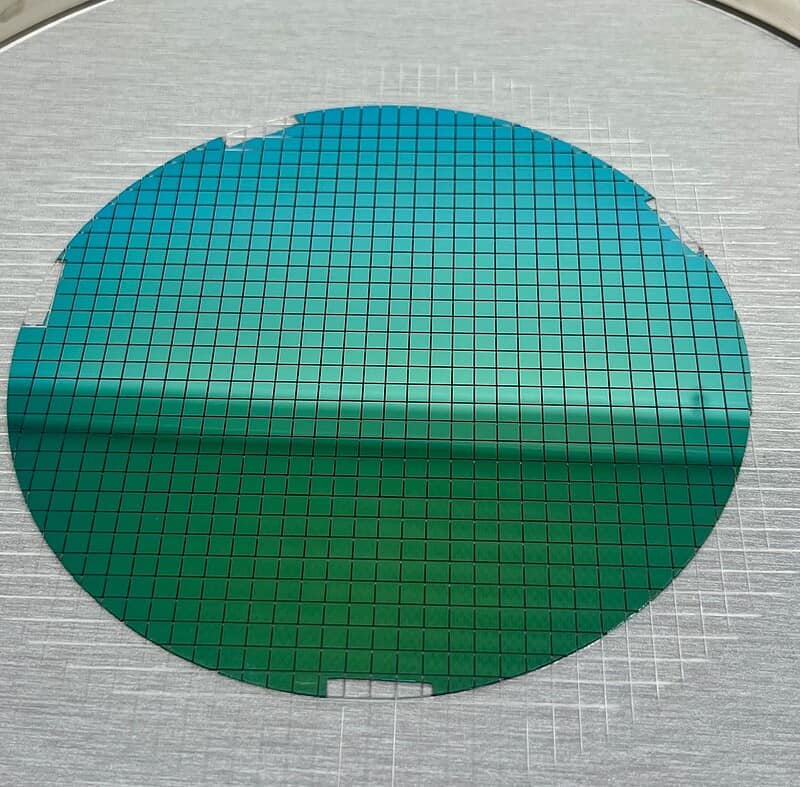
Kingsview Optical designs and makes custom bandpass filters by magnetron sputtering at our site in Rye, East Sussex. Tell us the centre wavelength, bandwidth and blocking you need, and we model the design, coat it, dice it to size and measure every batch, from prototype lots to repeat production.
- Magnetron sputtered in Rye
- Diced in-house
- Every batch measured
- ISO 9001:2015
What a Bandpass Filter Does
In short: a bandpass filter transmits one band of wavelengths and blocks the light either side of it. Three numbers describe it: the centre wavelength, the bandwidth (FWHM) and how deeply it blocks outside the band.
Our bandpass filters are interference filters. Dozens of thin, alternating layers of high and low index oxides set up interference that passes the design band and reflects the rest. Because the unwanted light is reflected rather than absorbed, the filter stays cool and the edges of the band can be made steep.
Magnetron sputtering packs each layer almost as densely as the bulk material. That keeps the passband where it was designed as humidity and temperature change, which evaporated filters can struggle with, and gives a hard surface that stands up to handling and cleaning.
The band moves to shorter wavelengths as the angle of incidence increases, and widens in a converging beam. Tell us the angle and cone angle in your system and we design for them. For UV bandpass filters in coloured glass, see our Schott UG filters.
Bandpass Filters We Make
Every bandpass filter we make is designed around your system, not picked from a catalogue. These are the families most of our enquiries fall into.
| Type | What it does | Typical use |
|---|---|---|
| Narrowband | A band from 10nm wide that isolates a single line or wavelength from a broad source. | Spectroscopy, gas detection, line isolation |
| Laser line | A narrow band centred on a laser wavelength, with deep blocking to clean up the laser's side emission. | Laser clean-up, Raman excitation, laser sensing |
| Broadband | A wide passband with steep edges, such as a single colour channel or the visible band only. | Machine vision, colour separation, imaging |
| Fluorescence | Excitation and emission filters matched to your fluorophores and light source, with deep blocking between them. | Microscopy, diagnostics, life science instruments |
How We Make Your Bandpass Filters
All four steps happen at our site in Rye, so you deal with one supplier, one purchase order and one lead time, from prototype lots to repeat production.
Where Our Bandpass Filters Are Used
Bandpass Filter Specification
Every filter is designed to your numbers. These are typical figures; if your design needs tighter, tell us which parameter. We'll tell you plainly whether we can hold it, and what it adds to cost.
| Centre wavelength tolerance | ±2nm |
|---|---|
| Bandwidth (FWHM) | From 10nm to over 100nm |
| Passband transmission | Typically above 90% average, depending on design |
| Blocking | Up to OD6, over the range your detector sees |
| Angle of incidence | 0° standard; other angles designed to order |
| Wavelength range | 300 to 3000nm, from the UV through the visible to the SWIR |
| Substrates | Fused silica, borosilicate and optical glass; we can coat your own substrate |
| Size | Coated on wafers up to 100mm diameter; diced filters from 0.8mm square, or single filters up to 100mm |
| Dimension tolerance | ±0.1mm standard; tighter on diced parts on request |
| Surface quality (scratch-dig) | 60/40 standard, 40/20 on request |
| Measurement | Every batch on a Perkin-Elmer Lambda 1050+, 200 to 3000nm; traces on request |
Not sure what to specify? Tell us your light source, your detector and the wavelength you need to isolate. We'll suggest a centre wavelength, bandwidth and blocking that work, and send a modelled curve with the quote.
Bandpass Filter Questions
What does FWHM mean on a bandpass filter?
How deep does the blocking go?
Why do sputtered filters stay on wavelength?
Does the angle of incidence change the filter?
Can you make prototype quantities?
What do you need to quote a bandpass filter?
Related Filters and Coatings
Getting a Quote for Custom Bandpass Filters
Send the spectral requirement, even as a sketch of the curve. An engineer from the team that would make your filters, not a sales team, will review it and tell you plainly what's achievable and what will drive cost.
What to send
- Centre wavelength and bandwidth (FWHM)
- Blocking range and optical density
- Angle of incidence, cone angle and polarisation if relevant
- Size, thickness and substrate preference
- Quantities: prototypes and expected production volumes
What happens next
- An engineer reviews itWithin one working day, confirming it's achievable and flagging anything that will drive cost or lead time.
- We model it and quoteThe quote comes with a modelled target curve to measure against.
- We coat, dice and measureAll in Rye, with measured traces if you need them.
Need a Bandpass Filter That Isn't in a Catalogue?
That's what our sputtering chamber is for. Send the curve you need and we'll come back with a design, a price and a lead time.
Made in Rye, East Sussex. NDA-friendly. Defence and security work welcome. ISO 9001:2015.